The music studio file
A control room looks like the easy case for a drink — hard floor, hard desk, nothing splashing underfoot. What it actually is: a room built to vibrate on purpose, laid out around one fixed chair, where every free inch of surface already belongs to gear that survives a spill worse than almost anything else in the house.
Nearfield monitors get placed in an equilateral triangle with the listening position — a geometry rule, not a style choice — because that's the only spot in the room where the stereo image sums correctly. That rule is also what fixes the engineer to one chair for the length of a session, which means everything that chair needs for six or eight hours, drink included, has to exist inside one arm's reach of it.
That reach doesn't have much slack. A benchmark producer desk like the Output Platform runs 60 inches wide by 36 inches deep with 9U of rack bays built into the frame and an upper monitor shelf at 36.5 inches — a genuinely large footprint that still fills immediately with a MIDI keyboard, a mouse zone, controllers, and the monitors themselves sitting directly on the deck. Rack gear is cut to a hard industry standard — 19 inches wide, one rack unit (1U) equal to 1.75 inches — which is why a desk's capacity gets quoted in U, never in the diameter of a cup. Whatever's left after the gear claims its share is the only surface a drink is allowed to touch.
Hard and flat is supposed to be the forgiving case for a drink. The complication specific to this room is that the surfaces are built to move: studio monitors exist to push air, and their cabinets transmit that motion straight into whatever they're sitting on. Monitor isolation pads are a real accessory category sold in pairs for exactly this reason — to decouple the speaker cabinet itself from the desk, because the alternative is a cabinet that walks.
A container standing nearby rides the same vibration the pads are fighting. Tipping is a leverage problem — the taller a container is relative to the width of its base, the less force it takes to push it past its balance point — and a bass-heavy pass through the nearfields supplies that force for free, again and again, for the length of a session. Engineers describe the result plainly: the low end hits, the desk hums, and a can that was sitting still starts creeping toward the edge on its own.
The damage isn't hypothetical, and it isn't small. Studio forum threads document a full cup of coffee going into a digital mixing console and draining straight out through the power supply and the XLR jacks. Another describes milky coffee across a MIDI controller that needed contact spray and fader cleaner to bring back, with only partial recovery. A third documents half a cup of black coffee into a synth straight out of the box — the advice afterward was to seal it with desiccant, open the case, clean the contacts with high-percentage isopropyl alcohol, and leave it powered off for days before finding out if it survived.
The recovery ritual repeats across enough of these threads to count as its own body of forum lore: cut power immediately, never power the unit back on wet, disassemble what can be disassembled, clean with isopropyl, and wait two to four days before testing. Sugared and milky drinks come up again and again as the worst case, because what corrodes contacts and gums up faders is exactly what fuels a late session — coffee and energy drinks, not water. It's specific enough that some studio owners post a literal boundary line: drinks allowed on the couch side of the room, banned outright at the mix position.
The instinct is to clamp something to the mic stand, and the market answers with hundreds of listings — Mr. Power, On-Stage's MSA5050, Gator Frameworks, and dozens more. The recurring complaint across reviews is a mismatch: a clamp sized for one stand's tube slips or sits crooked on another, fixed rings around 3.25 inches only accept standard-width bottles, and open-ring designs let a narrower can tip free the moment the stand gets nudged. Every version also assumes a spare stand exists to clamp onto in the first place.
Spiral rod holders solve the clamp problem and create a new one: the original SwirlyGig is sized for half-inch rod, the larger version for one-inch, and neither transfers to a different stand or attaches to a desk at all — it's built for a stage, not a studio. Desk-edge clamps look like the answer for the desk itself, but the recurring review pattern is a plastic clamp that doesn't inspire confidence and won't open wide enough for a thick desktop or trim — and on a producer desk, the edge is already spoken for by the keyboard tray and the rack bays, so there's often no clean lip left to clamp onto anyway.
None of that is a materials problem — it's a geometry problem. A holder that only works on one tube diameter fails the moment the session moves to a different stand or a bare desk. A holder that clamps to an edge fails the moment the edge is already claimed by a keyboard tray. What the room actually needs is something that doesn't care what surface it's on and doesn't ask the vibration to stop.
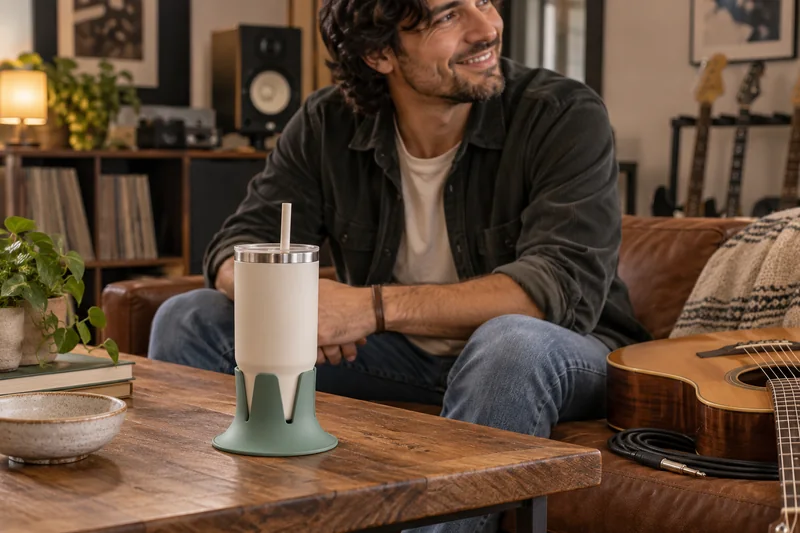
That's the case for a wide, flexible base that spreads its grip across the desk instead of balancing on a single point, with fins that hold a container by its bottom inch instead of clamping to something the room wasn't built to be clamped to. A base like that settles in on a hard, vibrating desk the same way it settles in anywhere else, resists tipping through the reach and the bass note instead of needing either one to stop, and holds steady whether it's sitting on the desk, the console top, an amp, or the floor.
That's the whole case, and it's a modest one: a drink that stays where it's set doesn't need a stand, a clamp, or a rule taped to the wall to survive a session. It just needs a base built for the room it's actually in.
Build yours — ships freePurchases go through steadilabs.com — the maker, directly.