Free shipping on every order · 90-day guarantee · Molded in Orange, California
The Music Studio Cup Holder.com

Finally, somewhere to put your drink that isn't on the gear.

4.9 from 119 Steadi reviews

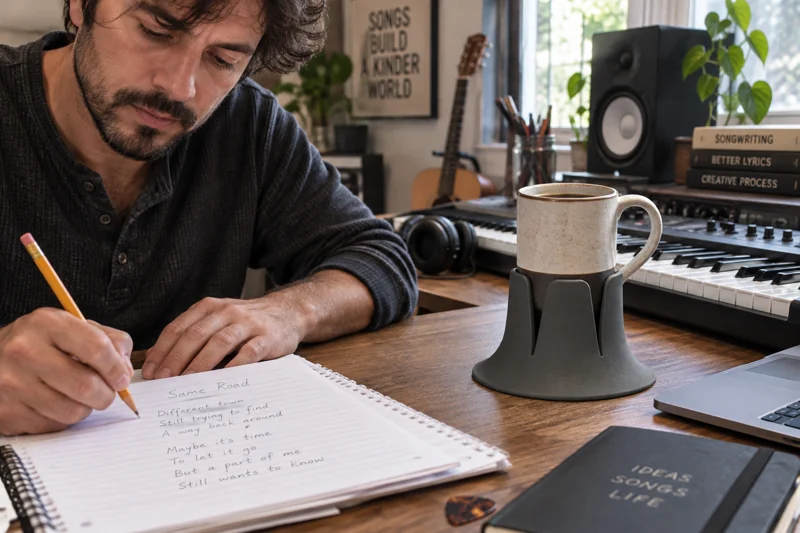
A wide flexible-finned base that holds your coffee or energy drink steady at the mix position — through the reach, the sub, and the rolling chair — off the console top and clear of the patchbay underneath.

Get the base — from $14.95

Free shipping · 90 days of real sessions to test it · molded in small runs in Orange, California.

Will your cup clear the mix position? A sticky note answers it — the test is below ↓

Prefer the maker's own store? steadilabs.com →

Left to right: the wide, low base empty, then holding a cup, a can, and a large tumbler.
One base, nowhere near the faders. Empty, then a cup, a can, and a 40 oz tumbler — same base, same grip, nowhere near the faders.

The setup

Every flat spot at the mix position already belongs to something else.

Nearfields get set in a triangle around one chair — the sweet spot — so everything a session needs, drink included, has to live within reach of that seat. Producer desks are drawn up in rack units and cable runs, never in cup diameters, so whatever's left over sits directly above the gear.

The desktop, inside the reach.

The only bare patch of desk is the one the elbow sweeps through to ride a fader or grab the monitor knob — so the coffee lives exactly there, an inch from the DAW window and the interface.

The console top.

The flattest, most obvious ledge in the room sits directly over the fader slots, the patchbay, and the power supply. Most studios post a rule against setting anything there — and an eight-hour session is the first thing to forget it.

The monitor and sub tops.

Nearfields exist to move air, and whatever sits on top of one rides that vibration for the length of the session. Isolation pads are sold by the pair to keep the speaker itself from walking; nothing's sold for the drink.

The floor by the chair.

Once the desk and the console are ruled out, the drink goes down — into the path of rolling casters, the headphone cable, and whichever foot moves first when tracking starts.

The vocal booth.

Hot tea travels in and out between takes because there's nowhere to leave it in the booth or the control room, so it rides the same hand about to put headphones back on.

None of it is carelessness. The gear got a home; the drink never did — so it borrows whatever surface is free for the length of a take.

You know the moment

You've mixed through this hour before.

Hour six, mid fader ride

The reach for the fader or the monitor knob sweeps the elbow through the one clear patch of desktop — the exact spot the coffee's been sitting since hour one, an inch from the interface.

Sub on, playback loud

The low end hits and the desk hums with it. The can that was sitting still starts creeping toward the edge, riding the same vibration the isolation pads under the monitors exist to kill.

Between takes, vocal booth

The tea comes back out to the floor by the mic stand because it isn't allowed anywhere else, and the headphone cable sweeps past it on the way back in for the next take.

Playback night, clients in the room

Someone who doesn't know the rules sets a glass on the rack top or the console's armrest, and the engineer spends the next verse watching a condensation ring form over the gear instead of listening to the mix.

2 a.m., session running long

The chair rolls back and forth between the desk and the rack in a dim room, and the energy drink balanced somewhere near the casters is the sugariest liquid in the building — right above the gear that survives sugar worst.

The goods

Three reasons it survives the session.

01

Stays put through the vibration

The wide, low base spreads its grip across the desk instead of standing on a point, so it settles in even with the nearfields humming next to it and holds through a bass-heavy pass instead of creeping toward the edge.

02

Holds what actually gets carried into a session

The travel cup, the energy drink can, the water bottle, the 40 oz tumbler. Cans and bottles slide straight on; mugs and tumblers drop in through the fins and get gripped by the bottom inch.

03

Doesn't need to match your gear

No tube diameter to size, no desk edge to clamp onto, nothing to carry along if the session moves to another room. It sits on whatever's flat — desk, rack top, amp, floor — and holds on its own.

How it holds

Built to outlast the vibration and the reach.

The base spreads its grip.

A studio desk looks flat but it's covered in gear, cable runs, and constant vibration. The wide, low base holds its footprint across the surface instead of balancing on a narrow point that a hum or a nudge can tip.

The fins hold from the sides.

Flexible fins grip the container by its bottom inch, so a can or a cup can't rattle loose when the sub hits or an elbow brushes past on a fader ride.

It settles back.

A reach across the desk, a chair rolling past, a bass note through the nearfields — the low, wide base rocks with the disturbance and brings the drink back level instead of letting it ride the vibration to the edge.

Nothing clamps to anything. No tube diameter to match, no desk edge to grip, no stand to mount it to. It sits on top of whatever surface is free — the desk, the console, the amp, the floor — and works the same on all of them.

Vibration, mapped

Every surface here is flat, hard, and moving anyway.

Hard and flat should be the easy case. The complication is that a control room is built to vibrate on purpose, and nearly every ledge in it has electronics running directly underneath.

The desk top

Birch or MDF, hard and flat on paper — except a benchmark producer desk already gives up most of that footprint to nine rack units of bays, a keyboard tray, and monitors sitting straight on the deck. What's left is inside the elbow's reach to the faders.

The console top / patchbay

The flattest ledge in the room sits directly over the fader slots, the patchbay, and the power supply. A spill here doesn't stay on the surface — it drains straight through the switches to the electronics underneath.

Nearfield and sub tops

Nearfields exist to move air, and their cabinets carry that vibration constantly — strongest on a bass-heavy pass. An entire accessory category, isolation pads, exists just to keep the monitor itself from walking off this surface.

Synth and keyboard panels

The flat end-cheeks and the space above the keys read as shelf room, but the key contacts and circuit boards sit immediately underneath — closer to a spill than almost anywhere else in the room.

The floor by the chair

Below the desk and the console once both are ruled out — dim light, rolling casters, and a cable run that doesn't care what's in its path.

Why drinks tip at the mix position — and what actually holds one steady — the full story →

Quick check

One sticky note off the monitor answers the whole fit question.

your cup's base
lands in here

A square sticky note: 3 inches, exactly — same as the ceiling of what fits, off the fader bank first.

01
Grab a sticky note.

A standard sticky note is exactly 3 inches square — a fact about sticky notes, and it doubles as the outer limit of what the base holds.

02
Stand the cup on it — off the desk first.

Set the note down anywhere but the fader bank and stand the cup on it before it goes back near the gear. Check the bottom, not the rim — mugs flare and tumblers taper, and only the base decides.

03
Read the result.

Base fits inside the square? It's in range. Base spills past the edges? Too wide. A small footprint stranded in the middle, well under 2 inches? Too narrow to grip.

No calipers, no spec sheet, no guessing between takes — just a sticky note off the monitor bezel and the cup that's headed back to the desk.

The fit list

The bottom inch decides what stays off the gear.

One rule decides every line below: a base 2 to 3 inches across settles in and holds.

  • Coffee mug, handled handle in the way
  • 40 oz Stanley-style tumbler fits
  • Energy drink can fits
  • Travel mug, handle-less fits
  • Singer's water bottle fits
  • Hot tea, throat-coat fits
  • Beer bottle or can fits
  • Whiskey glass fits
  • Espresso cup too narrow

There's a floor here too — under 2 inches the base sits too loose to trust an inch from the interface. The handled mug is the one honest exception: the base itself is in range, but the handle sits exactly where a fin needs to grip.

The full fit database — Stanley, Red Bull, Yeti, and 30 more, with sourced base measurements →

Versus the fixes

What's already been tried, clamped, and banned.

A clamp-on mic-stand cup holderThe Music Studio Cup Holder
Which mic stand it fitsOnly the diameter it's sized forDoesn't need a stand at all
No flat surface nearbyClips to the stand — solves itNeeds something flat underneath
Through a bass-heavy passOpen rings can let a can tip freeRocks, settles back down
Setting it up the first timeRight size, right washers, or it wobblesSets down, holds, done
Moving desk to amp to boothStays clamped to that one standMoves with you, no attaching
What's left after months of useCheap plastic clamp, per reviewsOne molded piece, nothing to loosen
CostAnother purchase — and a stand to ownOne small piece, no add-ons
Clamp-on mic-stand cup holders

Sized for one tube diameter, so a clamp built for one stand slips or sits crooked on another. Open-ring versions let a can tip free the moment the stand moves, and every model requires owning a spare stand to clamp it to in the first place.

Spiral rod holders (SwirlyGig-style)

Each version is sized for one specific rod thickness — the standard for half-inch tubing, the larger for an inch — so it doesn't transfer between stands and has no way to attach to a desk at all. It's a stage accessory, not a studio one.

Desk-edge clamp holders

The recurring complaint is a plastic clamp that doesn't inspire confidence and won't open wide enough for a thick desktop or trim. On a producer desk the edge is already claimed by the keyboard tray and the rack bays, so there's often no clean lip left to clamp onto.

The posted no-drinks rule

It reads well on the wall and loses to an eight-hour session — the coffee comes in anyway, and banishing it to the couch or the floor just trades an elbow knock for a rolling chair caster.

Coasters and koozies

They stop rings and condensation, not knock-overs. Neither one does anything about an elbow mid-fader-reach or a can walking across a vibrating desk.

From the reviews

What buyers say.

Recent reviews of the Steadi, from every room and rig it lives in.

★★★★★

I have a tendency to spill my drinks and have two cats. This is one of the best things I’ve ever impulse bought. It works. It actually works. It’s a heavy, wide enough base that it is actually stable. My “spot” in the living room is near a somewhat-cushioned fabric ottoman, which is where I usually put my drinks. It’s

Dixie · 2026-08-30
★★★★★

I love mine. I just wish the price was more appropriate. $15 seems a lot for a small plastic item. Reduce it to $9.99 and free shipping and I'll buy a few more!

Carolyn G. · 2026-08-27
★★★★★

Excellent!

Brian S. · 2026-08-27
★★★★★

Thank you for your service!

Brian S. · 2026-08-27
★★★★★

It’s great love it

gilbert a. · 2026-08-24
★★★★★

I never knock over my water at night anymore!

Customer · 2026-08-21

Read all 119 reviews →

All 119 reviews are for the drink base itself, collected across every place people use it.

Why more than one

Two identical cans. One console.

A co-writing session or a client sitting in usually means two identical energy drink cans end up on the same crowded console top — same brand, same size, no way to tell whose is whose by hour four. Reaching for the wrong one, or nudging it toward the patchbay, is its own small tax on a long night.

Build your set

Give everyone their own.

Pick a pack, then give each one a color — so nobody has to ask which drink is theirs.

Q & A

Asked between takes, answered here.

Does it actually work on a hard desk?

That's the surface it's built for. Hard, flat surfaces are the easy case — the wide base and the fin grip hold at least as well there as anywhere else, vibration included. It settles in on the desk, the rack top, or the console the same way.

Will it hold up to monitor and sub vibration?

That's the actual test in this room. The wide base spreads its grip across the desk instead of balancing on a point, so a bass-heavy pass or a nearfield humming next to it settles the drink back instead of walking it toward the edge.

Will my tumbler or cup fit?

Measure the bottom, not the rim. A base of 2 to 3 inches across settles in — the 40 oz Stanley does. Handled mugs don't; the handle lands exactly where a fin needs to grip.

Does it clamp to my desk, stand, or rack?

No. Nothing clamps to a tube diameter, a desk edge, or a mic stand. It sits on top of whatever's flat — the desk, the console, an amp, the floor — and works the same on all of them.

Is it safe to use near the console or the interface?

An open drink is still an open drink — nothing changes that near electronics. What this does is resist tipping in the first place: it holds steady through the reach, the vibration, and the rolling chair that usually causes the spill.

Will it work in the live room, not just the control room?

Yes — it holds the same way on an amp top, a rack shelf, or the floor by the mic stand. The surface changes; the base and the fins don't.

What about the vocal booth?

It's small enough to sit just inside the booth instead of out on the floor by the mic stand, so the tea or the water bottle isn't riding the headphone cable on every trip in and out.

How do I clean it?

Rinse it under the tap or wipe it down, or put it in the dishwasher. It's one piece of molded material with no seams and nothing to come apart, so there's nowhere for a coffee spill to hide before it heads back to the desk.

Who makes it, and where do I buy one?

It's called the Steadi — molded in small runs in Orange, California by Steadi Labs, veteran-founded and patent pending. Free shipping on every order from steadilabs.com, with 90 days to send it back if it's not for you.

All 18 questions, answered →

Provenance

Built with the same precision as the gear it sits next to.

The maker is Steadi Labs, a small veteran-founded company in Orange, California. It's injection molded in small runs, and nothing about it travels far — the mold, the material, and the color runs all sit within about three and a half miles of the shop. The people who make it read hello@steadilabs.com themselves, usually before the first session of the day.

Ninety days of real sessions.

Run it through a month of sessions. If it doesn't do what this page says — on the desk, through the vibration, with your cups — email hello@steadilabs.com and it gets made right. No forms, no fight.

Veteran-founded · Patent pending · Made in Orange, California

Nothing on the console but the mix.

The drink holds steady at the mix position — on the desk, off the gear — and the next reach for the fader doesn't need to detour around a spill.

Get the base — free shipping, from $14.95

Checkout is on steadilabs.com — Steadi Labs is the company that makes it.